

by Caroline Bedford, CEO, EDII
This is the second part of a series of articles about development for leaders. You can read part 1 here.
In my last piece I asked what it would take to make development sound like what it is – something successful people do.
And here is where I think the real challenge lies.
Too much development offered to accomplished people fails not because it’s too uncomfortable, but because it isn’t uncomfortable enough.
Executive development can respect experience so thoroughly that it never really questions it. Nobody challenges the COO on operations, the senior broker on distribution, the head of claims on claims – because who would?
And so the people with some of the most experienced judgement in the industry can become the least likely to have it tested, retested and stretched.
That matters more than it used to.
As technology becomes more capable, professional judgement doesn’t become less important. It becomes concentrated in the decisions where context, ambiguity, consequence, and accountability matter most.
AI can process more information, identify patterns and increasingly support analysis and decision-making. But someone still has to understand what matters, recognise when something doesn’t fit, weigh competing interests, question the output and decide what to do.
And judgement only stays sharp if something pushes against it.
I know this from my own side of the table. I’m coached, and the sessions that have changed how I run EDII weren’t the comfortable ones. They were the ones where someone who understood my business well enough to be specific asked a question I’d stopped asking myself.
It’s also how we work at EDII. We do to ourselves what we ask of the people in the room: question the thing that’s working, challenge the assumption behind it, build something better – then question that too.
So back to my question: what does development have to get right to deserve the time of people who’ve already made it?
I think it comes down to credible challenge – and whether you’ve earned the right to bring it.
Challenge has to be credible
If an underwriter has to explain the basic realities of underwriting before they can engage with the idea being explored, something has gone wrong.
The same is true for brokers, claims leaders, technologists, and the many other disciplines that make insurance work.
To ask experienced insurance professionals to examine their judgement, assumptions, or established approaches, you need to understand the context in which those things were formed: regulation, distribution structures, legacy technology, competing commercial interests, customer pressures, and the practical reality of trying to change something inside an insurance business.
Without that understanding, challenge becomes generic – and experienced people dismiss it, often rightly.
There’s a saying I’ve always liked: never take criticism from someone you wouldn’t take advice from.
Most accomplished professionals probably live by some version of it. And it sets a high bar for development. If you want someone to examine the judgement they’ve built over 15, 25 years and more, you need to have earned the right to ask the question.
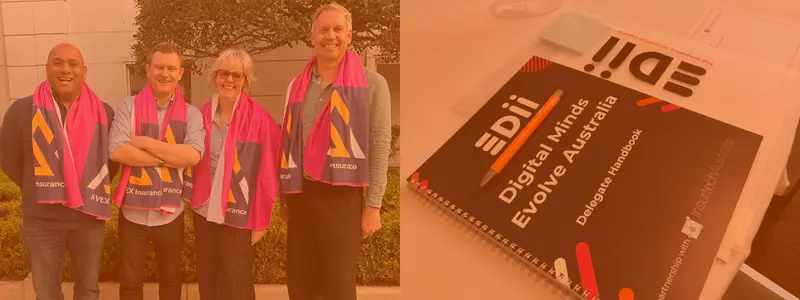
That’s one of the principles that shaped Digital Minds Evolve.
We deliberately mix insurers, brokers, MGAs, and insurtechs. Everyone in the room understands the market, but they don’t necessarily see it in the same way. A broker can challenge an underwriter’s assumptions. An insurer can question how a technology business sees the problem. Someone who has spent years inside one part of the market gets to see it through another.
The expertise in the room isn’t something to work around. It’s part of what makes the challenge valuable.
The EDII leaders guiding that challenge are selected for the experience they bring – years spent working through change and transformation in insurance, expertise in innovation, and continuing involvement in a market that is still evolving. That matters. Frameworks and new approaches can help, but they aren’t enough on their own. You need to understand where established judgement has come from, when it deserves to be challenged, and when a different perspective can make someone look at something familiar differently.
For experienced professionals, the value isn’t simply in being taught something new. It’s in having their thinking challenged by people whose experience and perspective they respect. In some ways, the proposition is quite simple: let’s examine the things you already know – including the things you’ve become very good at – and see whether they still hold.
It has to be hard enough to be worth their time
There’s a catch to everything I argued in my last article.
We can’t solve a positioning problem with positioning alone.
If we want accomplished insurance professionals to see development as part of high performance, the development itself has to deserve that status.
A better label on conventional training won’t do it. Neither will a comfortable two days spent agreeing with people who already see the world in much the same way.
That means giving experienced people problems without obvious answers. Putting them alongside people who see the market differently. Asking them to try unfamiliar approaches, test assumptions, and explain and defend the decisions they’ve made.
That’s much closer to what I think development for accomplished people needs to be: not an environment designed to expose what they don’t know, but one that makes them work harder with what they do know – and question some of it.
The question worth asking instead
So perhaps the question for insurance organisations isn’t simply where the capability gaps are.
At EDII, we’d frame the better question the way we frame any problem worth solving – as a “how might we”:
How might we create a culture in which our most accomplished insurance professionals see continuing development as part of being accomplished?
That’s the shift I think we need to make in insurance.
Not development as evidence that something is missing, but development as evidence that someone intends to keep getting better.
Because becoming accomplished shouldn’t be the point at which development matters less.
It should be the point at which we expect more from it.