

by Caroline Bedford, CEO, EDII
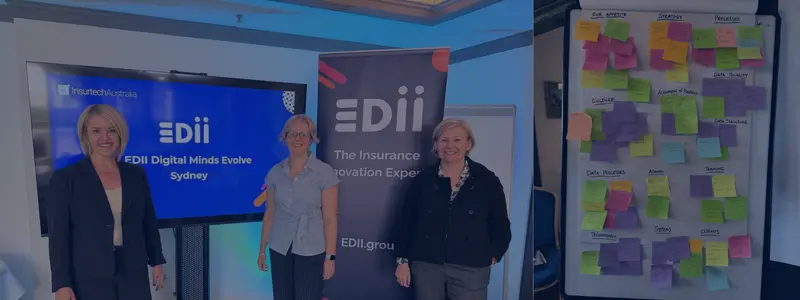
Last month we ran the first Australian cohort of Digital Minds Evolve, our two-day programme for insurance leaders, in partnership with Insurtech Australia.
Delegates came from across the market – insurers, brokers, MGAs and insurtechs – and spent two days working on a realistic case: a fictional insurer with recognisable problems, a brief to build a case for change, and a board to present it to at the end.
Something struck me when the presentations began.
The teams had AI, data and technology fully on the table. Nothing stopped them building their case around a platform decision, automation or new technology. But that wasn’t where most of the conversation went.
What dominated was people, decision-making, leadership and governance. Technology featured, but largely as an enabler of the argument rather than the argument itself.
Given the freedom to propose almost anything, experienced insurance professionals kept coming back to how an organisation thinks, decides and leads.
It reinforced something years of working with people across the insurance industry has taught us: transformation rarely succeeds or fails on technology alone. It’s what people do with it that matters.
It also brought me back to something else I keep noticing.
We’ve now run Evolve five times, across the UK and Australia. Each cohort has been a different mix, but the people in the room have had one thing in common: they’re accomplished, they’re curious, and they’re there by choice. Nobody is in that room because something is broken.
Then I step outside the room, and listen to how our industry talks about development – and the language doesn’t match the people. Skills gaps. Training needs. Upskilling. Areas for improvement. Development as something we do when something is missing.
That’s not a criticism of development teams – the language is inherited, built into budget lines and competency frameworks, and goodness knows, many are already pushing against it.
But the clash is what I can’t let go of. If this is what development looks like in practice – successful people choosing more of it – why does the way we talk about it still describe a remedy?
Development has a positioning problem
There’s nothing inherently wrong with any of those terms. Sometimes there is a specific capability someone needs to acquire, and good training is exactly the answer.
But collectively, they can create a powerful association: development is what happens when you’re not yet good enough at something. And that’s strange, because we don’t apply the same logic to every form of development.
We don’t generally talk about an MBA as something you undertake because you’re struggling. Executive education carries status. At its best, executive coaching carries almost the opposite implication: this person is serious enough about their performance to keep investing in it. I do, myself.
These forms of development are associated with ambition, progression, intellectual curiosity, and high performance. Yet much workplace development is still positioned around what’s missing.
Perhaps the problem isn’t that experienced insurance professionals don’t value development. Perhaps we haven’t made enough forms of development feel like something successful people do precisely because they’re successful.
The gap isn’t the problem
Accomplished professionals have capability gaps. Of course they do. I do. Everyone does.
The problem is when the gap becomes our default reason for development.
If our starting point is always “what’s missing?”, we overlook many of the other reasons experienced people continue to develop. Their environment changes, their responsibilities expand, technology alters the decisions they make, and they encounter problems their previous experience hasn’t prepared them for.
Experience itself creates something worth examining too.
Years in insurance give people things you can’t shortcut: pattern recognition, judgement, context and instinct for what will and won’t work in this market. Inevitably, they also create established ways of working.
Approaches that succeed get repeated and, over time, become instinctive. That instinct is enormously valuable. But as the environment changes, there is value in periodically examining whether the approaches that have served us well still do.
It’s like the way elite athletes continually revisit and refine techniques they’ve practised thousands of times. Nobody interprets that as evidence that they’ve forgotten how to compete. The refinement is part of what keeps them performing at the highest level.
Why wouldn’t we think about professional capability in the same way?
From acquisition to examination
Much professional development asks: what do you need to learn?
That’s an important question. Throughout our careers, we need to acquire new knowledge, techniques and capabilities.
But for experienced professionals, I think we should be asking another question too: what is worth examining?
What has become instinctive because it has worked before? Which assumptions are shaping the way I approach this problem? Whose perspective am I not seeing? Is the way I’ve always approached something still the best response?
This isn’t about stripping away experience. It’s about extracting more value from it.
Across the five Digital Minds Evolve cohorts we’ve now run, we’ve seen what happens when experienced insurance professionals challenge themselves to work on ambiguous problems alongside people with different perspectives on the same market.
An insurer sees something differently from a broker. An underwriter brings a different lens from someone building an insurtech. Someone who has spent years solving a particular kind of problem encounters a technique from another discipline and sees another way into it.
Sometimes development gives you something you didn’t have. Sometimes it helps you see differently what you already possess.
Experienced professionals need both.
So here are the questions I keep coming back to: to some, why does development still sound like a remedy once people are successful? And what would it take to make it sound like what it is – something successful people do?
I’d be genuinely interested in your answer to that second question.
In my next piece: What good development actually looks like for people who’ve already made it – and what it has to get right to deserve their time.